Part of my continuing effort to make snow look appealing.
“I prefer winter and fall, when you feel the bone structure of the landscape—the loneliness of it, the dead feeling of winter. Something waits beneath it, the whole story doesn’t show.”
Thanks to everyone who attended my presentation last night at Professor McNutt’s Johnson Shoyama Graduate School of Public Policy class on policy analysis. It was great to meet you. Thanks for your enthusiasm and your questions. As promised, here’s my presentation:
I’m all in favour of governments looking into things and being proactive in researching complex topics. However, I have to confess the whole thing makes me feel a bit queasy.
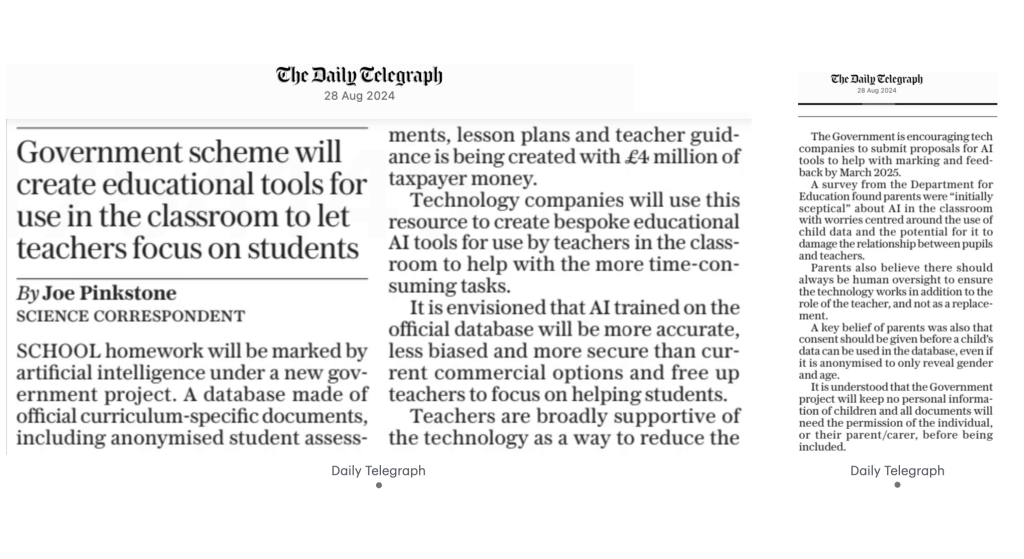
The new UK government has earmarked (UK) 4 million, selling the plan as a mechanism for reducing teacher workload. My one great hope is that any new technology introduced into the classroom is geared towards improving the student learning experience.
And the only what to do this successfully is through deep and meaningful consultations with the teaching profession. Unfortunately, the Govt of Saskatchewan hasn’t had a good track record in this area. What with the pronouns bill and cell phones in the classroom, it seems to be act first without broad-based discussions. That just creates more problems down the road.
A few snips of what I consider to be the best bits:
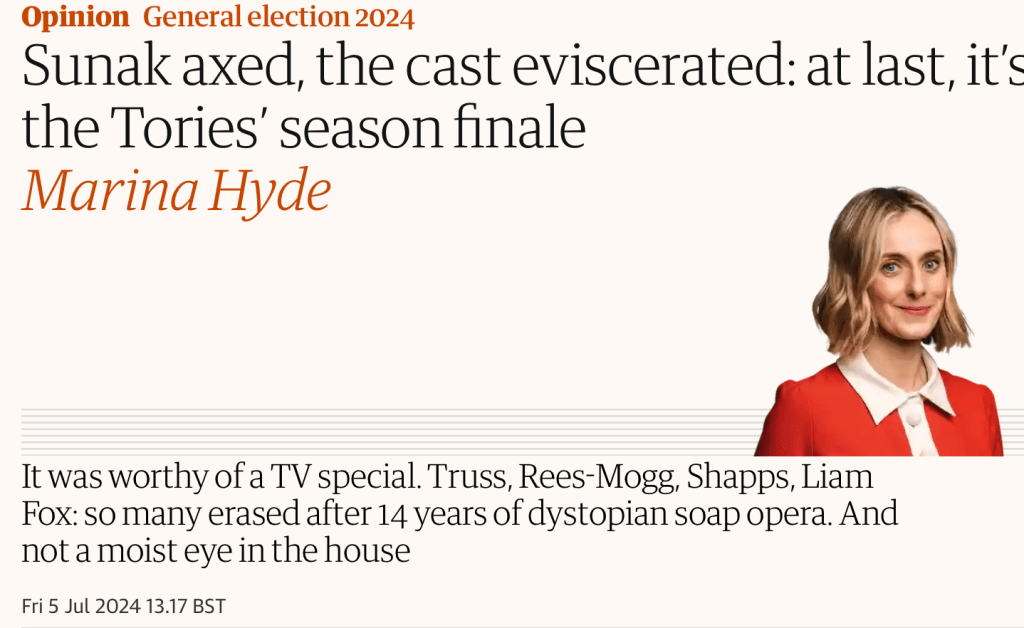
I expect the UK Conservative leadership contest will begin in earnest any time now. Apparently, leading right-wing candidate Suella Braverman had to be talked out of announcing her leadership bit at her constituency results announcement.
Apparently good taste and sound judgments aren’t always coincident with political ambition. In any event, the fight for the “soul” of the Conservative Party (or what ever is left) will be entertaining.
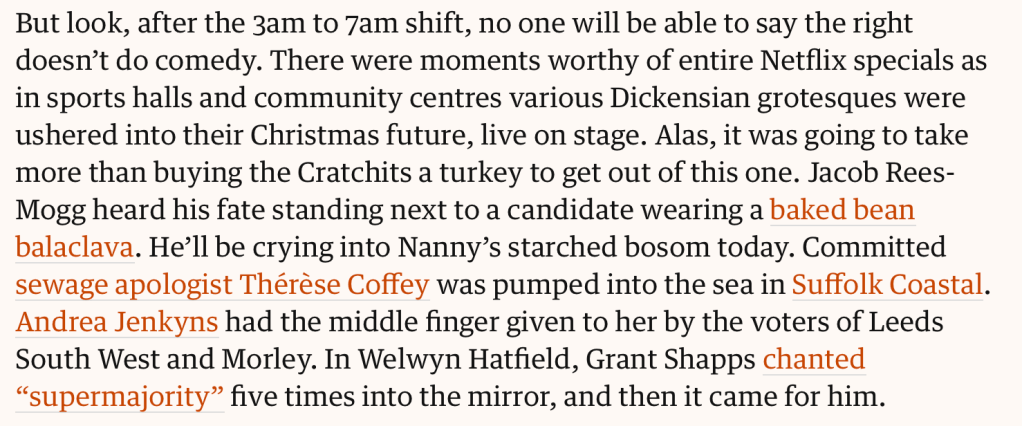
From today’s Times of London, a reminder of just how brutal and unforgiving politics can be. It seems former Prime Minister Boris Johnson and current UK Prime Minister Rishi Sunak buried the hatchet long enough to appear at the same late-night campaign. However, no handshake and not on the stage at the same time.
Every political speech comes equipped with built-in opportunities for the crowd to demonstrate their love and enthusiasm for the speaker. So it was no surprise when the audience erupted into chants of “Boris Boris Boris”.
Unfortunately, efforts by the current Prime Minister’s staff to launch similar displays of adulation for their boss fell conspicuously flat.
It seems like the die is cast an the results are a foregone conclusion. UK voters head to the polls Thursday, July 4.
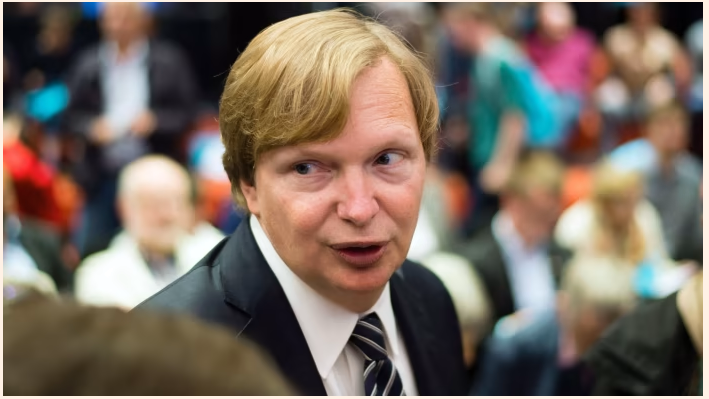
I was listening this week to Jim Messina, known in Washington DC as “The Fixer”. From 2009 to 2011, Messina served as deputy chief of staff for operations under President Barack Obama. Messina was also campaign manager during Obama’s 2012 successful re-election campaign
Financial Times, 12 June 2017
Messina told Politico reporter Anne McElvoy that he is watching the UK election race very day, and he still has no idea what the Conservative’s message is.
The Tories seem headed for one of the worst electoral defeats in British history, with even Prime Minister Rishi Sunak and his Chancellor set to lose their seats in parliament.
Front page, Daily Telegraph, 20 June 2024
The problem, according to Messina, is that voters don’t seem to understand what the Tory message is anymore. It’s as if the party is speaking, but no one is listening.
Part of this is due to the fact that Conservatives have been in power since winning the 2019 General Election. People seem simply tired of them.
However, Messina thinks another factor is in play. If you look at the UK Prime Minister’s daily events, you will see him standing at a podium featuring three or four separate slogans, which is confusing for voters.
Contrast that with the UK’s Labour Party, which has stuck religiously to a single message: Change. Messina says elections are decided by ordinary voters who don’t think about politics much, as they go about their daily lives.
“The most important thing is message to voters. People, at least in the US, think about politics four minutes a week and the have two and a half jobs. And you have to have a very clear message about what you are going to do to make their lives better. And I think too often make it too confusing and too complex.”
Jim Messina, Politico Power Play Podcast, Episode 40, 19 June 2024
In a separate but clearly related point, Messina also discusses the importance of message discipline. Even if you have a single, clear message, success will be elusive if you fail to deliberately concentrate on the consistent delivery of that message.
“I used to say to Barack Obama, every day you are talking about yourself, we lose because incumbents usually lose referendums on themselves.”
Jim Messina, Politico Power Play Podcast, Episode 40, 19 June 2024
This might be a useful reminder for politicians in Saskatchewan, attempting to defend their record or aspiring to the Office of the Premier. Every day that you are off-message is a day that the seed you are attempting to plant in the mind of the electorate might fail to germinate.
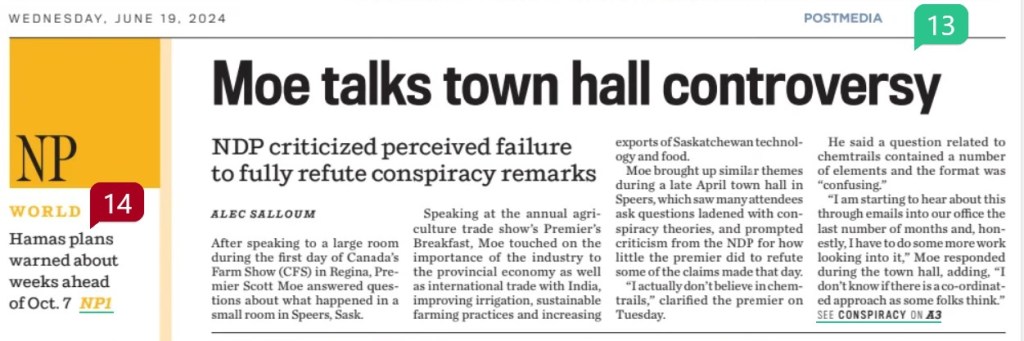
Every day you are talking about whether or not you believe in chemtrails or rebuffing calls for an investigation into alleged harassment of Saskatchewan’s Speaker of the Legislative Assembly is a day you are not articulating your core message. Nor are you comparing and contrasting your record with the record of your opponents. Yes, there is still plenty of time before the next Saskatchewan provincial general election in late October. However, as Messina states in his interview time is the only thing you can’t get more of in politics and time is always running-out.
Not only is message clarity important for external audiences, it is also important for internal political audiences. Those who are newly elected or re-elected need to be incredibly clear in stating their goals and priorities, when dealing with public servants.
This point was driven home recently by UK policy advisor Polly Mackenzie. She says politicians and the staff they hire must be absolutely clear and consistent on what structural and systemic changes they want to see during the term of a government. The people you surround yourself with as you govern take on a great importance:
There has been kind of a growing tendency to have special advisors, across the spectrum actually, who are very young, exuberant and enthusiastic about briefings and playing kind-of-political games. If you are expecting to go into potentially a two or three term government and do serious things for the country, the kind of people you need about you as a new Minister, and I think special advisors are important and the yare important for more than just press relations — they bring a kind of intellectual perspective a challenge into the civil service–that sense of who are the minds you want about you, to help you navigate the incredibly complicated and difficult world of policy and system change.
Polly Mackenzie, How to Win an Election podcast, The Times, 18 June 2024
Finally, after 45 continuous years of employment in journalism, politics and the education sector, I find myself heading into retirement in a matter of days. It has been a difficult year in education. So I would like to extend my best wishes to all of the teachers in the province. I hope you all have a restful summer and experience nothing but success and satisfaction in the coming years.
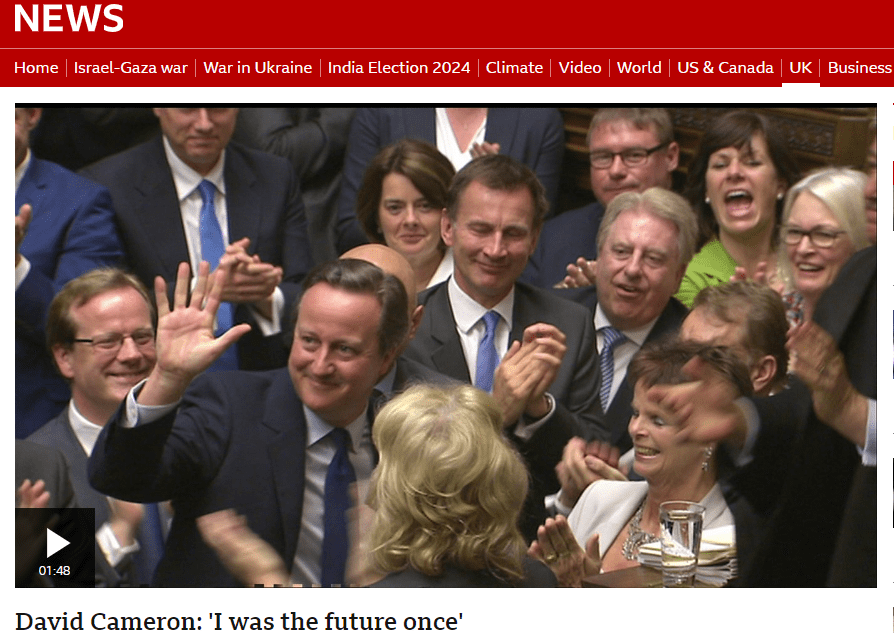
And while I may not have agreed with all of his policies (most particularly his Brexit strategy), I do find former UK Prime Minister David Cameron had a wonderful way of saying good-bye to his friends, colleagues and opponents during his final Prime Minister’s Questions in July of 2016 . You can watch it here:
To paraphrase and adapt to my own circumstances, I will say that people enter into the education sector with huge passion for the students in their care. They enter the profession with great love for public education and a strong desire to transmit the knowledge needed for young people to become productive and informed members of our larger society.
And from my new spot on the sidelines, I will be willing you on and wishing you every success.
Everyone in Saskatchewan should be interested in elections and campaign strategy. We’re about to get a bunch of elections. People across Saskatchewan will vote in a province-wide election at the end of October (or possibly sooner, but I somehow doubt it). Municipal and school board elections take place in mid-November, I’m sure just has voter fatigue begins to set in. And as we have seen with the recent announcements by two high-profile candidates for Mayor of Saskatoon, we are about to get inundated with campaign literature, political messaging and promises of future performance. So many promises.
Thus, it behooves all of us to seek out information, make comparisons and exercise our franchise in a critical and responsible manner. And, for those who want to take matters a step further, I’ve accidently discovered a podcast from The Times in London that does an excellent job explaining the behind the scenes work done in organizing a major political campaign. Yes, it’s from the UK. However, after listening to several episodes, I have discovered this podcast, along with being entertaining, does a great job at shedding light on the strategies, tactics, organizational and logistical challenges and personalities involved in the political process. In so far as these successful electioneering concepts cross party lines and cross-pollinate through national boundaries, it holds much of relevance for Saskatchewan and Canada (in fact, several recent episodes have mentioned how UK Conservatives are now focused with horror on Canada’s 1993 election where our Tories were reduced to just a pair of seats).
The podcast is called How to win an Election and is available on Apple Podcasts and all of the other usual locations.
The program is hosted by Times Radio presenter Matt Chorley who does a commendable job of allowing his guests the room to develop their answers. Chorley also has the sadly rare skill of asking questions that are actually questions–giving program participants something to chew on.
.About the only sour note in the entire program (literally and metaphorically) is the theme music, which some may appreciate but I find particularly grating. In fact, the annoying nature of the theme music has become something of a running gag in recent weeks.
The regular guest commentators are three giants in recent UK political life: Daniel Finkelstein, Peter Mandelson and Polly Mackenzie.
Mackenzie is a well known and well respected policy expert who negotiated the Liberal Democrat-Conservative coalition and then spent five years working with deputy prime minister Nick Clegg in Downing Street (she may look back on this period with mixed feelings since significant cuts and restraint during the Cameron years probably led to a long period in the political wilderness for the Lib-Dems).
“I’m excited to pick apart the twists and turns of the looming election with this supremely experienced panel, who’ve seen elections from inside and out, upside and down, and every side of the track.”
Polly Mackenzie, UK Podcasting Today, 20 October 2023
Peter Mandelson is a giant in UK politics. He’s a former Labour cabinet minister, an advisor to Neil Kinnock, John Smith, Tony Blair and Gordon Brown. Mandelson is one of the engineers of New Labour’s massive election win in 1997.
“There is no better time to put election campaigns under the microscope and ask how Labour is going to end its long run of election losses and whether the Tories still have some fight left in them.”
Peter Mandelson, UK Podcasting Today, 20 October 2023
Daniel Finkelstein is to Conservatives is what Mandelson is to Labour. He’s been a key advisor in successful campaigns led by David Cameron and the unsuccessful campaign led by John Major. Baron Finkelstein (OBE) is also former executive editor of The Times and continues to write an excellent weekly political column. He was also an unsuccessful Conservative parliamentary candidate for Harrow West. (There’s no shame in political advisors losing elections. One of the greatest minds in American politics, JFK speechwriter Ted Sorensen, ran and bombed spectacularly. Strategic excellence may not always translate into success at the retail politics level).
“I don’t think you can be a proper democrat without understanding how the electorate really thinks and how they react to things. And I want to test all the ideas that political science, my own experience and reading other people’s experiences brings.”
Daniel Finkelstein, UK Podcasting Today, 20 October 2023
The 11 June 2024 edition of How to win an Election was particularly insightful. The regular panel was joined by Frank Luntz, the American pollster and political strategist. I first became aware of Luntz with this 2007 book Words That Work (https://www.amazon.com/Books-Frank-Luntz/s?rh=n%3A283155%2Cp_27%3AFrank+Luntz) It’s a book that focuses on the language of politics, and includes a lesson that political strategists ignore at their peril: When it comes to creating political messages, “It’s not what you say, it’s what people hear”.
Luntz said the differences between American and UK national elections are striking. He says UK election campaigns deal with issues in a more substantial way. There is less talk about issues and policies in the US campaign and the UK campaign is far more serious.
Luntz said the UK is heading towards “one of the biggest landslides I have every seen in my professional career”, with Labour set to win an even bigger majority than Tony Blair’s massive win in 1997.
“I was involved in the Canadian election in 1993, where the Conservative Party went from 157 seats to two in one night. I worked for the Reform Party. I’ve been apologizing for that for the last 30 years. It destroyed the Conservative Party.”
Frank Luntz, How to win and Election podcast, 11 June 2024
Just one year ago, Luntz made a presentation to the 1922 Committee, the group of UK Conservative backbenchers. Their deliberations are supposed to be confidential. However, Luntz’s pronouncements were immediately leaked to most major news outlets. At that time, Luntz said any MP with a majority of 15,000 votes or less was in real trouble. Luntz said recent events have proven him wrong. The actual number is now 20,000 votes or less. Any majority less than that is almost certain to be insufficient for Tory candidate re-election.
Luntz says three simple words come to voters’ minds when they think about UK Conservatives: Ignored, forgotten, betrayed.
Ignored–that their voice doesn’t matter. Forgotten, that they were promised something and they never delivered; And the worst of all is betrayed. When you feel betrayed, that’s what makes you angry. When you feel betrayed, you want to vote against. And that’s why the (UK) Reform Party is doing as well as it is.”
Frank Luntz, How to win an Election podcast, 11 June 2024
According to Luntz, voters aren’t looking for pragmatism, because that suggests a politician will say anything to secure your vote. He says voters are looking for common sense ideas and political leaders who are willing to be less ideologically driven.
“Your show is called “How to win an election”. The very first thing you have to do is ask a question. Ask the voters: Are you angry? Are you satisfied? Do you think you’re going to have a better future? Are you better off today? Ask them something. I don’t hear that (from the UK Conservatives). The second thing is to have is an acknowledgement that you hear them and that you understand them and that you ‘get it’. I don’t hear that from the Conservatives, either.”
Frank Luntz, How to win an Election podcast, 11 June 2024
Luntz also had some critical comments for UK Labour, currently more than 20 points ahead and overwhelming favorite to win the next election. He said with that lead, Keir Starmer should be willing to sacrifice 20 seats of his majority and be brutally honest with voters and tell them exactly what a Labour government plans to do in their first 100 days in office, and the first 1,000 days. Luntz says Labour is currently trying to blur issues and be overly simplistic in their commitments, but voters deserve to hear the truth and would respect politicians who are honest and specific in their approach.
Saskatchewan politicians facing the electorate in the fall might do well to consider the Luntz approach: A brutal and frank assessment of current challenges and a clear, specific list of common sense policies designed to improve the lives of the people who live here.
Near the end, Luntz says if the US election were held today, Donald Trump would win. Trump’s felony conviction on 34 counts of fraud has only cost him two points in the polls. The entire US election will come down to the results in Pennsylvania, Michigan and Wisconsin–states where Trump currently leads.
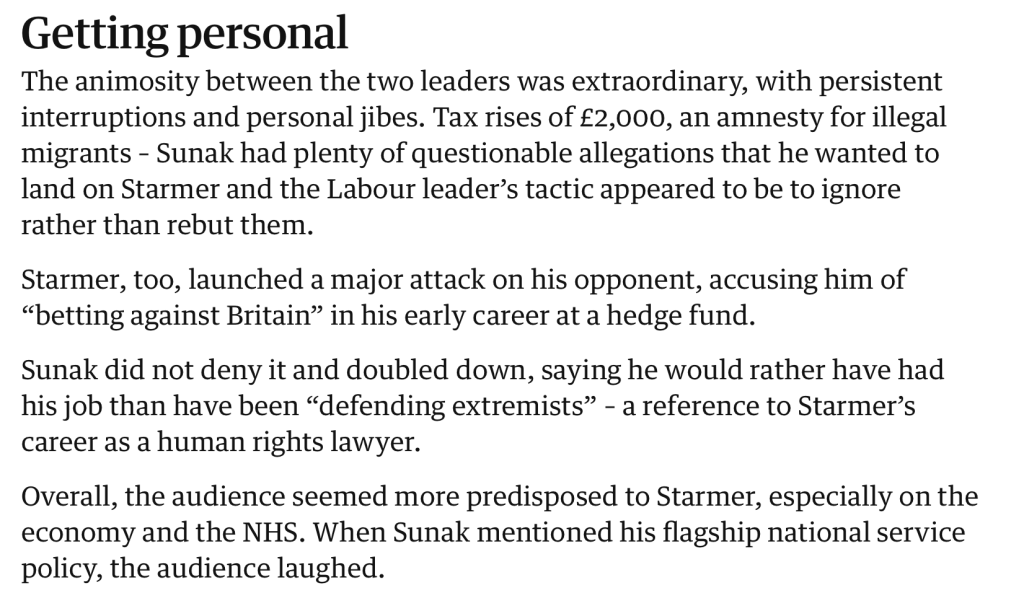
The leaders of the UK’s two main political parties entered into the first debate of that country’s general election campaign. Both promised to avoid personal attacks against the other. Like all pre-debate political promises, their pledge didn’t last very long.
Guardian 04 June 2024
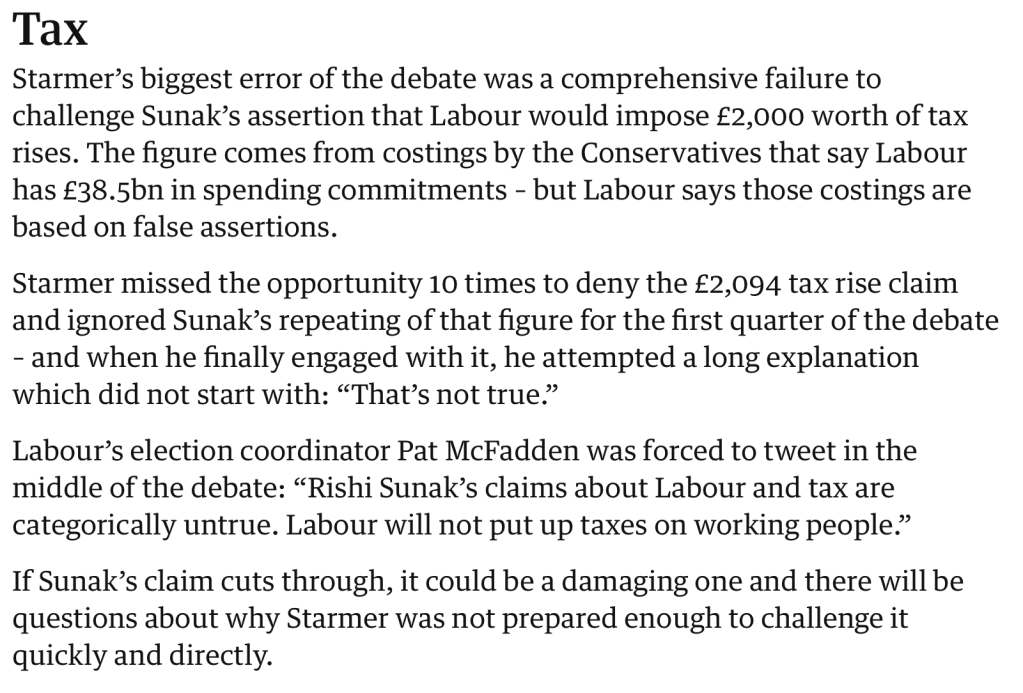
In a preview of what Saskatchewan voters will likely see this fall (and are already seeing on social media) the right wing Conservatives are attacking left-wing Labour with predictions of massive tax increases, a charge Labour seems to be ignoring to their peril.
Guardian 04 June 2024
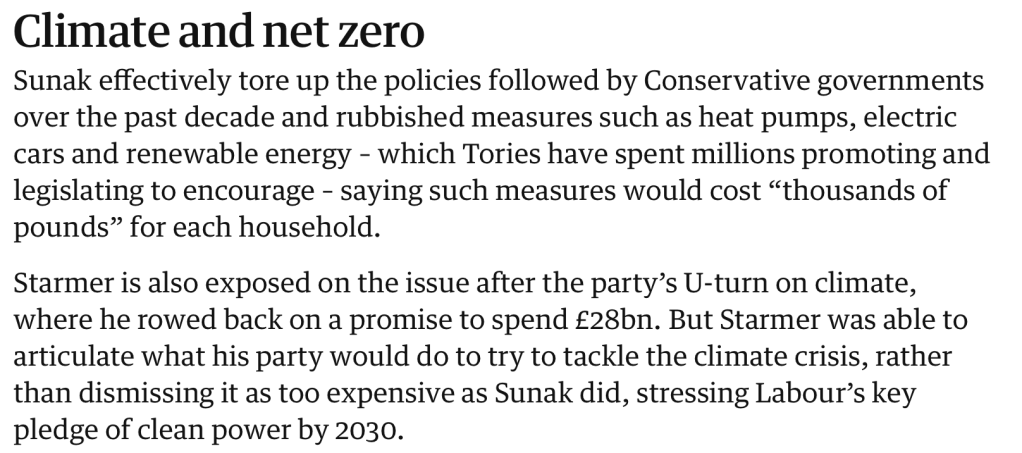
Sadly, both leaders seemed to back away from initiatives aimed at reversing climate change, potentially creating an opportunity for Britain’s Green Party, which scored numerous victories in recent municipal elections .
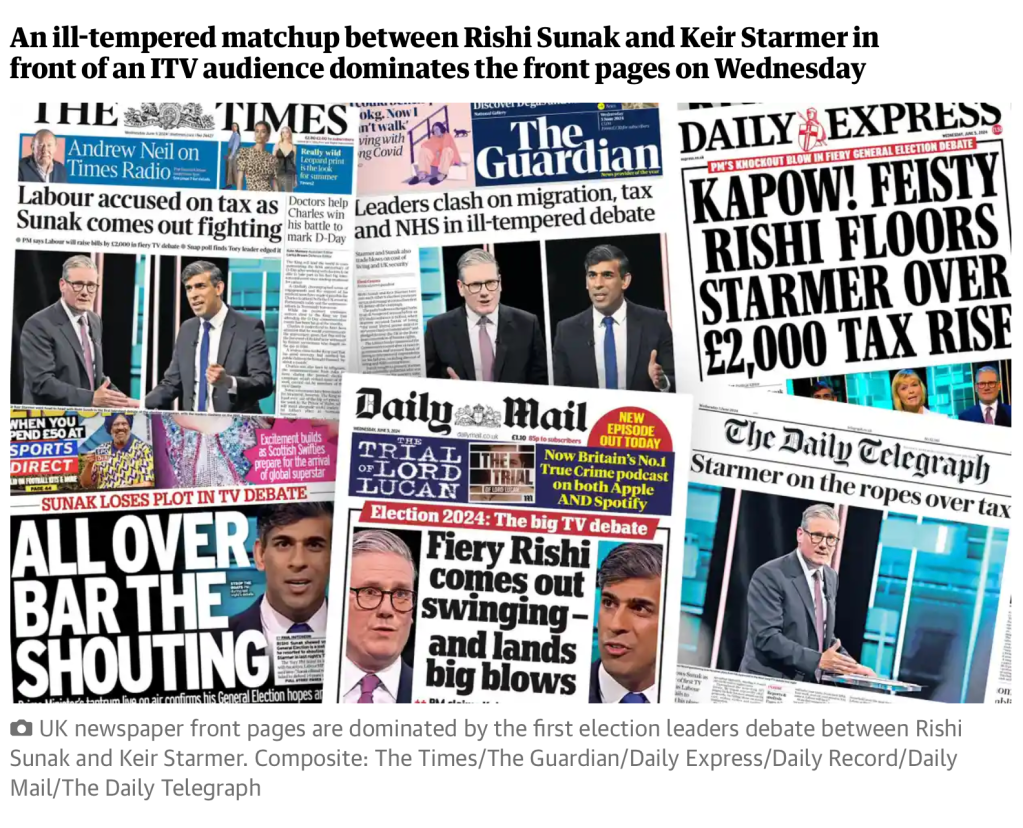
Inside the room, the audience seemed more supportive of the Labour Leader. Most of the UK’s right-leaning daily newspapers though (perhaps unsurprisingly) that the current Prime Minister won the debate.









 Ian Hanna