
Still lots of work ahead. But promising development. The Government-Trustee Bargaining Committee appears to have a new, revised mandate.


Still lots of work ahead. But promising development. The Government-Trustee Bargaining Committee appears to have a new, revised mandate.

The benches are hard and narrow. You can’t use your phone. Members on the floor of the Assembly don’t want you using your phone to take pictures of what they’re doing on their phones, whether it’s doing research, performing constituency outreach, watching Netflix or playing Candy Crush (https://leaderpost.com/news/local-news/sask-politics/bill-137-final).
However, if you want to find out what’s going on in a Ministry–where the priorities lie, where the money is going and perhaps some insight into the relationships between a Minister and his top officials, Estimates are a good investment.

Last year, Jeremy Cockrill’s predecessor, Dustin Duncan, held to custom and brought a handful of officials and staff to Education Estimates. Cockrill has been in the portfolio for less than a year. Perhaps that’s why he brought a large contingent with him for the evening, filling over half of the government benches (Last year, Estimates took place in a smaller room. This year, they were in the actual chamber where all house business is conducted.
However, somewhat curiously, Minister Cockrill (with two brief exceptions) did not allow those officials to speak. He huddled with them, sometimes at length, prior to answering questions from the Opposition. Now, many factors come into play when it comes to deciding who is answering what: a Minister’s comfort level, length of experience or a desire to save time by going directly to a well-versed subject-matter expert. For whatever reason, Minister Cockrill decided to answer most of the questions himself.
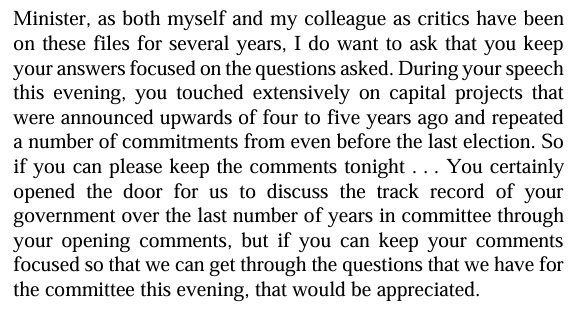
The mood in Estimates can vary, ranging from cooperative and pastoral to loud, partisan and confrontational. I would put the 2024 edition of Education Estimates somewhere in the middle. At times, there were solid exchanges of information. At other times, things seemed tense and tetchy. I got the sense there was no love lost between the Minister and Opposition Education Critic Matt Love. After a solid half hour of introductory remarks by the Minister, Love pleaded with Cockrill to be more succinct in his answers:
MINISTRY STAFFING LEVELS AND ARE THERE ANY TEACHERS ?
A standard opening question at these committee meetings is the comparison between staffing levels in the new budget, versus levels in previous budgets. It’s worth knowing whether a ministry is growing or shrinking and where resources are being funneled.
In this fiscal year (2024/2025) the Ministry of Education’s FTE (full time equivalent) count is 295.5. That’s an increase of 26 positions over the previous fiscal year. Cockrill said that entire increase is solely within the early years branch as the Ministry continues with establishing and staffing the regulated child care spaces under its $10 per day daycare agreement signed with the federal government.
As a former teacher himself, Matt Love has long been interested in knowing how many teachers work in the top levels of the Ministry of Education. Jeremy Cockrill said that’s not a number that is tracked.

Love then wondered if there’d be an “expectation from the public that there would be at least one individual who would be considered a teacher, an educator, who had spent at least part of their career working in delivering public education at the school division level involved in the leadership of the Ministry of Education?”
Minister Cockrill replied that he wasn’t going to speculate on the expectations of the public, but his expectation was that all ministry employees, regardless of professional backgrounds, would bring their best to their work each and every day.
FUNDING FORMULA
To say that the funding formula governing K-12 education in Saskatchewan is complex would be a bit of an understatement. There are many factors that come into play: the number of students, whether those students live in a few large centers or are spread more thinly, the social and economic characteristics of those communities.
Small changes in the formula can have large and expensive consequences for school divisions. So any changes in the formula are of great interest.
This year, Minister Cockrill said there was only one change: additional dollars are being provided to divisions if they see significant enrolment increases after the 30th of September.
Historically, September 30th has been viewed as an enrolment peak. Per student dollars are allocated on the basis of the head count on that date. However, several divisions, especially in Saskatchewan’s two larger centers, were noting significant enrolment after that date. The formula was changed to accommodate this, while maintaining the 30th of September as the main reconciliation date.
Here’s Minister Cockrill explaining the new changes to the funding formula:
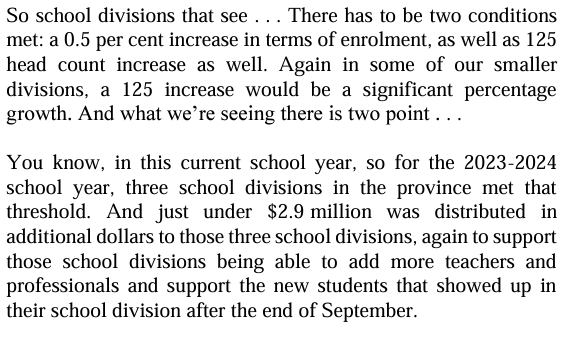
Province-wide, K-12 enrolment grew 3.2 percent from the 2022-23 school year to the 2023-24 school year. Projecting forward, Cockrill said school divisions are anticipating a 1.3 percent increase in the 2024-25 school year. However he cautions that ministry officials think that estimate might be low.
PER CAPITA VERSUS PER STUDENT FUNDING LEVELS
One of the rhetorical battles in Saskatchewan involves which data set you want to use to measure the level of investment in public education. To no one’s surprise, what you’re trying to prove has a big influence over which numbers you pick.
The Government of Saskatchewan uses Stats Canada’s per capita investment in education. Those numbers put Saskatchewan in first place for education funding. However, most other jurisdictions and Canada’s Council of Ministers of Education (https://www.cmec.ca/en/) use inflation adjusted per student operating funds–the dollars that actually get into the classroom. Use those numbers and the national comparisons start looking less attractive. In 2016, Saskatchewan ranked number one in the nation for per student funding. But, the province has been falling in the rankings since then, due to budget cuts and operating funding increases below the rate of inflation. Saskatchewan currently ranks 8th in Canada, and may drop to 10th this year.
Things got a bit heated when Matt Love asked the Minister why he always uses the per capita numbers:

LLOYDMINSTER WINS!
Lloydminster is a lovely city, full of lovely people, plopped right on the Saskatchewan/Alberta border. Given this unique situation, the city is governed by the Lloydminster Charter, a document ratified by both jurisdictions.
Unlike every other school division in Saskatchewan, Lloydminster’s divisions are allowed to charge an education property tax levy on home owners. (All Saskatchewan school divisions used to be able to do this, but authority was stripped away). The levy in Lloydminster exists to assure the quality of education is roughly equal, regardless of whether you go to school on the Alberta side or the Saskatchewan side.
In this budget, Saskatchewan responded to several adjustments to the funding formula that Alberta has made recently. That took the form of an $800,000 additional payment to Lloydminster’s Saskatchewan school divisions.
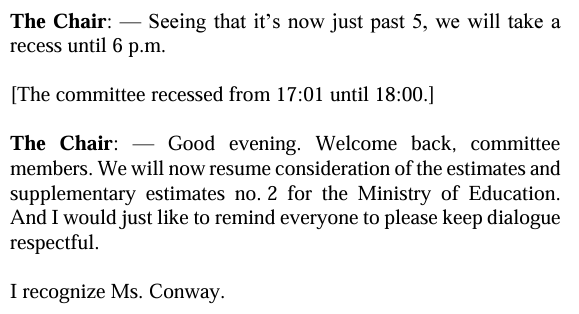
Following an hour long break, Regina Elphinstone MLA Meara Conway took over questioning for 60 minutes, focusing on Saskatchewan’s child care agreement with the federal government. Conway is the NDP’s Critic for Childcare and Early Learning.
Saskatchewan signed on early to the federal funding agreement, but has struggle since in terms of finding and training workers, getting those workers certified and developing new facilities to house childcare spaces. As Minister Cockrill said several times, it is complicated to move a largely unregulated sector into a regulated one.
At the end of December 2023, Saskatchewan’s total regulated spaces in operation or in development stood at 26,322. That’s an increase in total new spaces of 8,656: 4,345 are currently in operating, 4,311are in various stages of development.
The norm with federal programs is that the dollars flow in and are spent and accounted for by the provinces. Here in Saskatchewan, the Ministry has had to make arrangements to “carry forward” dollars that it was unable to spend in the current year to the next fiscal year. This is obviously not the best situation, since the tax dollars are provided for a specific purpose and are to be spent in the year allocated. In this case, Saskatchewan is moving about $95 million in unspent funds to the coming fiscal year.
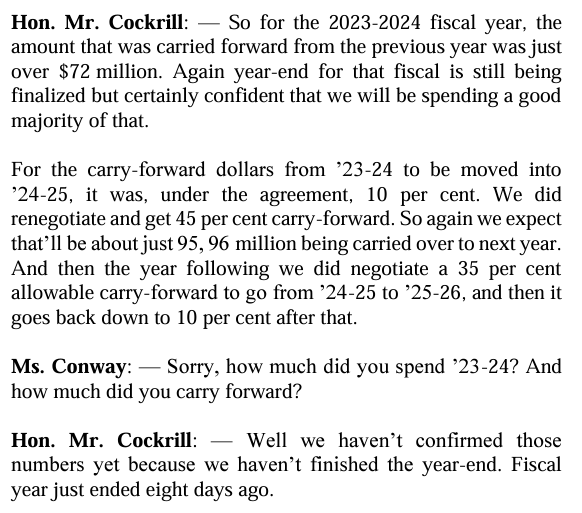
Minister Cockrill said the Ministry has been including child care spaces in new schools, investing in other infrastructure and working with various groups to expand public awareness about working in the sector. Cockrill said lots of work is being done and the Ministry is looking for “clear, implementable things that we can move forward with to expand the number of spaces”.
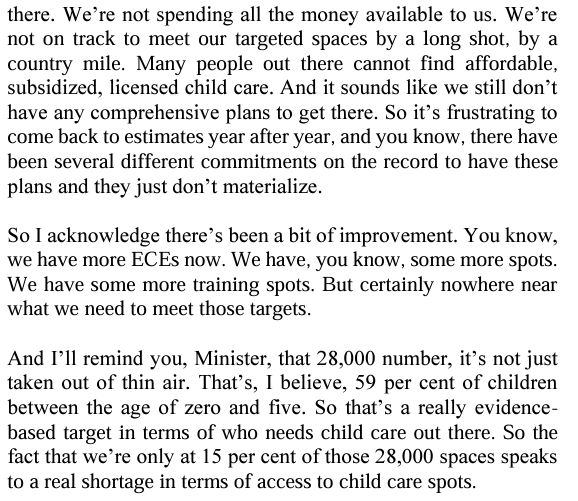
Conway said the bottom line is that under the federal program, Saskatchewan has managed to create only 15 percent of the targeted 28,000 spots.

HOW MUCH ARE WE TALKING ABOUT?
Following an hour of childcare questioning, NDP Education Critic Matt Love resumed his queries. On budget day, government loudly proclaimed an increase in education operating funding of $180 million. However, the actual operating line in Estimates (ED03 if you’re following in the full book, which can be found here: https://publications.saskatchewan.ca/#/products/123280) indicates a fiscal year over fiscal year increase of $158.8 million.
Cockrill said the apparent $21 million discrepancy can be traced to the difference between the fiscal year and the school year. When communicating with school divisions, it’s easier to talk about the school year number. According to Love, with factoring in the $40 million in extra funding provided in June, school divisions will actually have $140.23 million in new dollars to work with as they plan for the school year set to start in September of 2024. Love said the Minister may have moved towards providing more predictable funding, but whether that funding is sufficient to deal with problems that have been identified in Saskatchewan classrooms is another question. He doesn’t think it is. Cockrill disagreed.
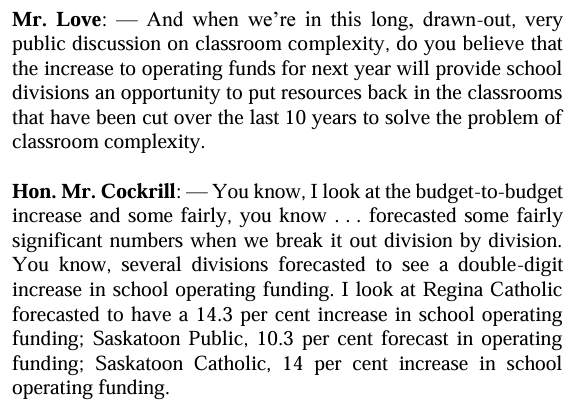
Cockrill expressed confidence that the current budget “starts to address needs that we are seeing in the classroom. And I certainly have trust in local school divisions to allocate these dollars responsibly and wisely in their respective jurisdictions”.
Matt Love disagreed.

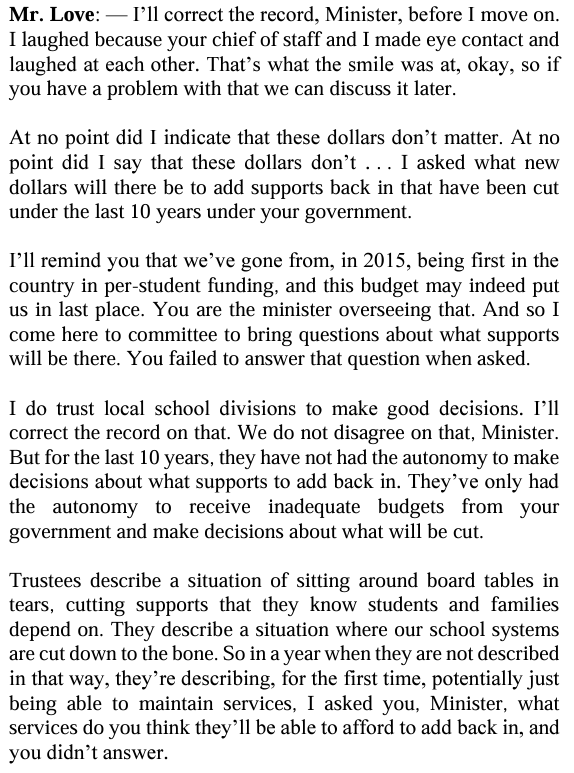
According to Love, 94 percent of the current operating fund increase will merely provide status quo funding to existing supports. Cockrill said he and Love would have to agree to have differing views on the budget. Then, once again, things got a bit tetchy with Cockrill accusing Love of being “ridiculous” when Love seemed to smile at the Minister’s answer.

TEMPORARY EXCLUSION OF STUDENTS IN PUBLIC EDUCATION
One of the things you hear in conversations about the difference between public and private education is that while private schools can pick and choose, public schools have to take every student that shows up at the door. During Estimates, I found out this is not perfectly true.
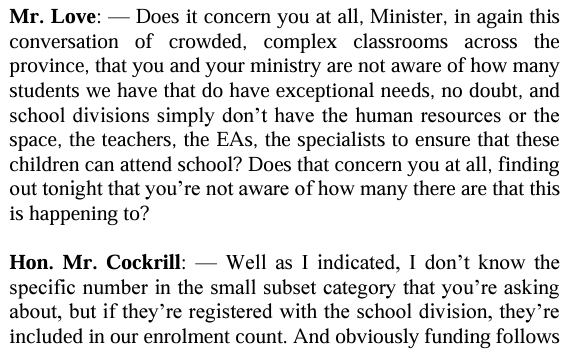
They’re called temporary exclusions. Under Saskatchewan’s Education Act, school boards have the ability to issue a temporary exclusion for a specific student, if the division does not have the supports available to ensure the safety of the student or others. Love asked if the number of these exclusions was increasing. Cockrill said he doesn’t know because that data isn’t tracked.


PRIVATE SCHOOL FUNDING
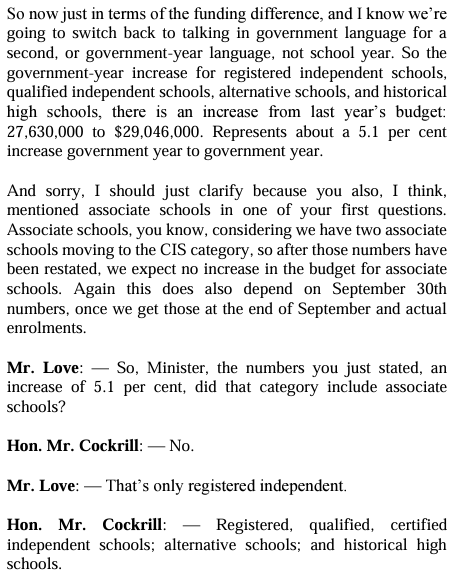
Last year saw a significant percentage increase in funding for private schools with the creation of new categories.
This year’s budget increase for private schools was just over five percent, although Cockrill said comparisons are difficult due to some schools shifting to a different classification.
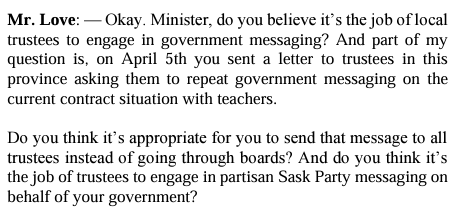
LETTER TO TRUSTEES FROM THE MINISTER OF EDUCATION
Love asked Cockrill about an April 5, 2024 letter sent by the Minister to all elected school trustees on negotiations for a new provincial collective agreement for teachers. According to Love, the letter included cryptic threats and was an attempt to have trustees echo government messaging on the dispute with teachers.

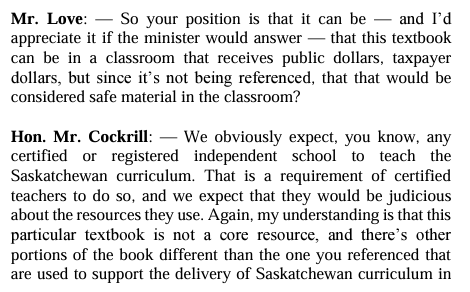
DINOSAURS AND HUMANS COEXIST?
Once again, a controversial biology textbook published by Bob Jones University gained attention. The book claims that humans and dinosaurs coexisted and in fact, still do coexist, with the Lock Ness Monster cited as “proof”. Love asked if the book is still being used in Saskatchewan schools. The Ministry says there are no banned books.

If you’d like to have a look at the complete record of these discussions, you can find it on the Saskatchewan Legislature website: https://docs.legassembly.sk.ca/legdocs/Legislative%20Committees/HUS/Debates/20240408Debates-HUS.pdf
One final point: this year’s Saskatchewan budget allocates $66.6 million for a new provincial collective bargaining agreement for teachers. Negotiations continue, but Cockrill has promised to fund the entire agreement, regardless of where the final number lands.
That commitment is important, because an agreement by government to fund a new teacher collective agreement has not always been in place.
On Friday April 5, 2024, the Saskatchewan Teachers’ Federation announced the beginning of work-to-rule measures, after another disappointing round of talks with the Minister of Education.
This is an extremely serious step. And let’s be clear how we got here. We are here because of an intransigent minister and an intransigent government who show zero interest in introducing class size and class complexity measures that are commonplace in collective agreements across Canada.
It’s a simple request, one that has been a part of the STF’s proposal package since the very beginning of negotiations. However, this appears to be a non-starter for a government bent on maintaining control at all cost. The Minister would rather deliberately mislead the public with false allegations about teachers trying to “move the goalposts”.
We are here because of this government’s complete lack of interest in funding publicly delivered, public education — to the point where they have allowed inflation adjusted per student operating funding to slip from first place in Canada in 2016 to likely 10th place after the implications of the latest Saskatchewan budget work their way through the education sector.
We are here because of this minister’s outright refusal to include one sentence in a new collective bargaining agreement:
“The parties agree that the Multi-Year Funding Agreement and the accountability framework will be followed and honoured.”
Instead of good faith bargaining, Saskatchewan’s Minister of Education would rather villainize teachers with silly billboards and bully school boards into silence.
He continually shows contempt for teachers and contempt for public education.
Jeremy Cockrill doesn’t care about public education. He has another agenda.
And because of his intransigence, students, teachers, parents and Saskatchewan writ large will suffer.
No one wanted this, but here we are.
And let’s be clear about why we are here.
Here is the latest STF News Conference with President Samantha Becotte:
In response to the Government of Saskatchewan’s continuing refusal to negotiate contract language on classroom size and class complexity, the Saskatchewan Teachers’ Federation today gave notice of a third consecutive day of job action. Withdrawal of noon hour supervision and extracurricular activities will take place at various locations across the province on Wednesday, February 25, 2024. This is consistent with the Federation’s earlier announcement that job action would escalate, if government failed to return to the bargaining table with a renewed mandate.
The entire news release can be found here:

Here are the locations where services will be withdrawn on Wednesday:
“Withdrawal of noon-hour supervision means STF members will not be available to supervise students who are eating lunch at school or taking part in noon-hour activities. Although teachers, including principals and vice-principals, often provide lunch break supervision, it is done on a voluntary basis. Student supervision is the responsibility of the school division. Withdrawal of noon-hour supervision will involve members from the following local associations:
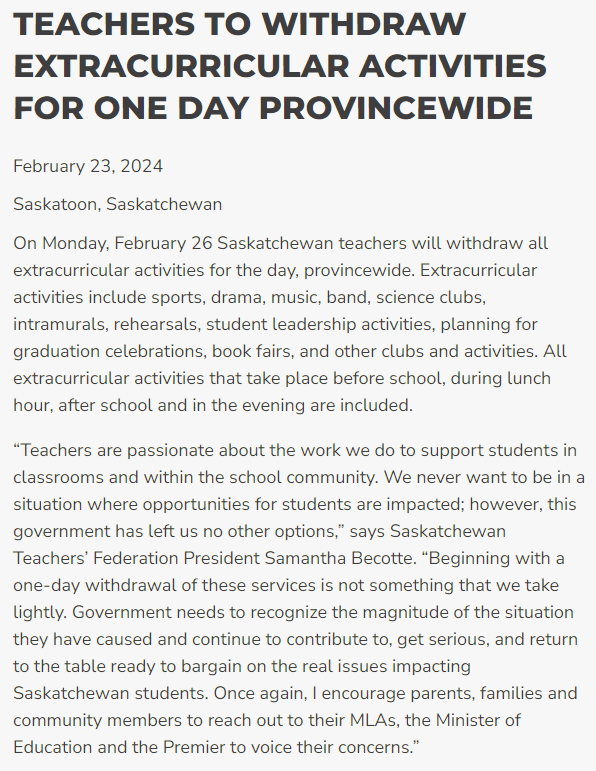
Withdrawal of extracurricular activities means that STF members who provide voluntary leadership of all extracurricular programs, including sports, non-curricular drama, music and band, science clubs, intramurals, rehearsals, student leadership activities, planning for graduation celebrations, book fairs, and other clubs and activities, will not be available. This includes activities that take place before school, during lunch hour, after school and in the evening. Withdrawal of extracurricular activities will involve members of the following local associations:
In 2016, Saskatchewan ranked first in terms of inflation adjusted per student operating funding. Now, the province ranks eighth.
This has had consequences. Student learning conditions are teacher working conditions. Our classrooms need more support.

Here’s a concise 20 minute summary of the current state of talks on a new province-wide collective agreement for teachers in Saskatchewan, along with an explanation of next steps.
And here is a link to the news release outlining the full set of sanctions teachers are imposing on Monday, 26 February 2024:
The entire news release can be found here:
This dispute would be easy to solve, if the government agreed to begin negotiating on language in the teacher’s province-wide collective agreement that deals with the pressing problems of class size, classroom complexity and violence in the classroom.
Two weeks before the resumption of the Saskatchewan Legislature and a month before the anticipated release of a 2024-2025 Saskatchewan budget, Cabinet has passed a series of special warrants worth hundreds of millions of dollars. These special warrants are a method of obtaining an approved appropriation (authorization to spend money). They are normally used when “…the Legislative Assembly is not or will not be in session for some time…”
https://www.fin.gov.nt.ca/en/glossary/special-warrant
Can the time period between now and the opening of the Saskatchewan Legislature on March 4, 2024 be legitimately defined as “…not in session for some time”? Your call.
Special Warrants are generally used in instances where there is some element of urgency that would require approval of spending without scrutiny by the legislative body.
Each signed Order in Council is preceded by a boiler-plate summary like this one, for the Ministry of Energy and Resources:

Translating that into people-speak, you’ve gone and spent all the money we gave you, but you urgently need to buy/fix/launch something we weren’t counting on when we released the initial funds in the budget back in March of 2023.
Notable additional expenditures this time around include $215m more for the SHA, $22m more for the Saskatchewan Cancer Agency (diagnostic and treatment trips to other jurisdictions??) and $200m for Physician Services (probably the new physician contract).
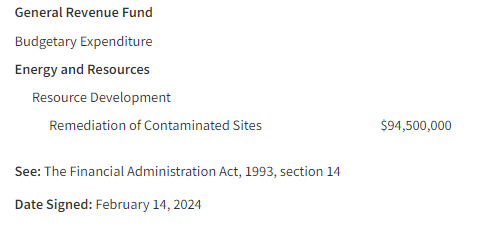
Notable as well is $114,785,000 for the Ministry of Environment and the Ministry of Energy and Resources for “remediation of contaminated sites” reopening the perennial can of worms about whether companies are being sufficiently held accountable when they leave behind a big mess.
Here are the details:
Ministry of Health: $450,100,000

Ministry of Education: $16,000,000
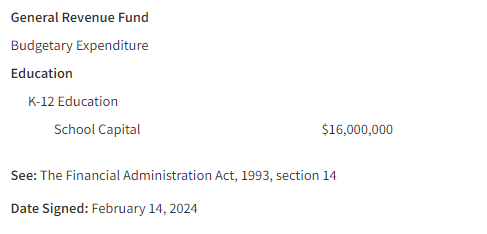
Ministry of Parks, Culture and Sport: $1,824,000

Government Relations: $17,688,000
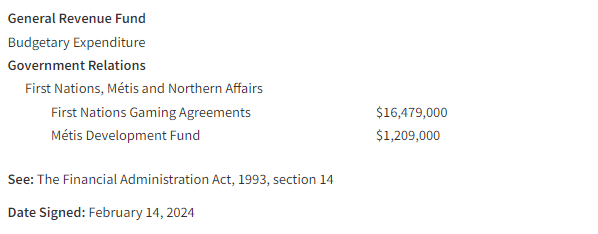
Ministry of Highways: $23,400,000

Ministry of Social Services: $22,750,000

Corrections, Policing and Public Safety: $8,968,000
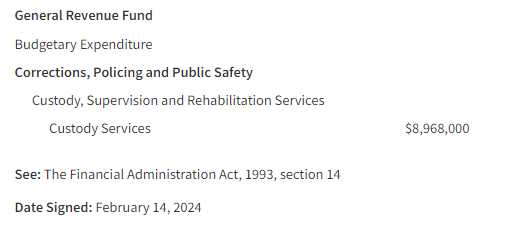
Justice and Attorney General: $1,664,000

Ministry of Agriculture: $86,321,000
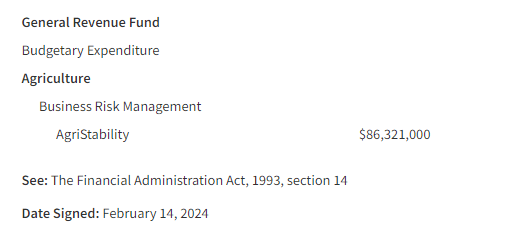
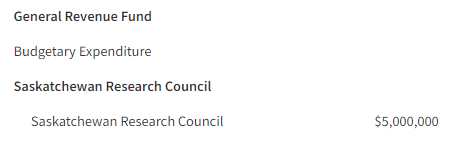
Saskatchewan Research Council: $5,000,000
Ministry of Environment: $20,285,000

Energy and Resources: $94,500,000
SaskBuilds and Procurement: $8,995,000

The grand total? $757,495,000. That means the budget and Estimates table this past spring were off by just a bit over three-quarters of a billion dollars.
Now, some might say I’m not being very generous and compared to spending of over $18 billion in the last budget, this additional spending borders on the insignificant.

However, they were out by four percent, which is a reminder that budget making at the provincial level is a human endeavor. It involves assumptions, forecasts and more than a bit of guesswork.
All Special Warrants and Cabinet Orders in Council are always available for public review at the following website: https://publications.saskatchewan.ca/#/categories/6156
Documents relating to the 2023-2024 Saskatchewan Provincial Budget are found here:
https://www.saskatchewan.ca/government/budget-planning-and-reporting/budget-2023-24/news-releases

Here’s a link to today’s Leader Post story featuring comments from teacher federation leadership across canada:
 Ian Hanna