In the weeks and months before an election, there is no such thing as a private meeting or off-the-record comments, as the UK Labour Party discovered recently when one of its candidates made some objectionable comments.
“There are even those who reckon it “a kind of blessing in disguise” because it has given a vivid warning to the party’s candidates to engage brain before opening mouth and to remember that there is no such thing as a truly “private” meeting. I’m sceptical that everyone will learn the lesson. It will not be at all surprising if secret recordings with incendiary content released at a time designed to cause maximum disruption are a feature of the general election campaign. History suggests it will not just be Labour that has made some unwise candidate selections.”
From today’s Sunday Times, a story about community recycling monitoring taken to the extreme:
In Berlin every block of flats has a communal bin house where you separate paper and cardboard, bio waste and Wertstoffe (all other recyclables). “There’s a fair bit of peer pressure to recycle properly,” says Oliver Moody, our Berlin correspondent. “The state of the bins and the assiduity of the sorting probably account for a solid quarter of the messages in our local WhatsApp group.” When a sleep-deprived Moody (accidentally) left a used nappy in the wrong bin, it caused a scandal. “We were singled out as dreckspatzen or ‘dirt-sparrows’.”
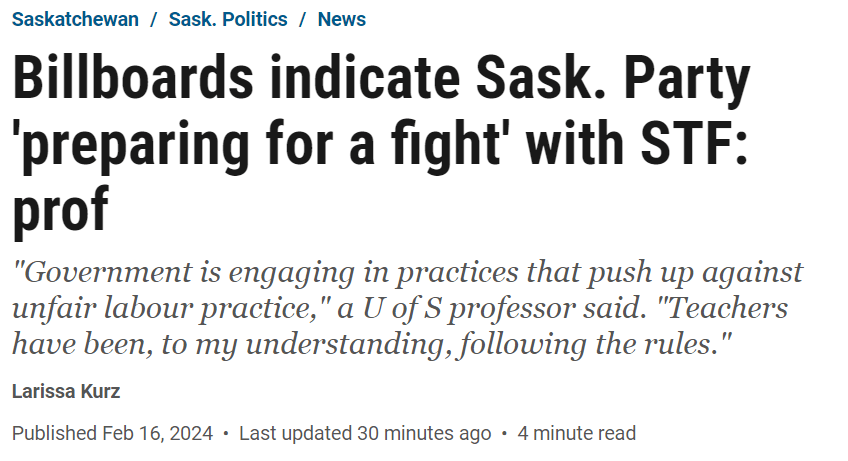
Today’s Regina Leader Post features an interesting story on the timing of billboards on teacher negotiations, paid for with tax dollars by Saskatchewan’s Ministry of Education.
The story, by reporter Larissa Kurz, can be found here:
Between June 2023 and November 2023, the Ministry of Education spent $145,000 on billboards and digital advertising. The money came from a public education fund set up for the government-trustee bargaining committee; in other words, dollars from taxpayers.
The billboards outline the government’s opening salary offer of seven percent, then go on to describe the average salary for a Saskatchewan teacher as $92,000, which the government claims is “more than others in Western Canada”. It is the position of the Saskatchewan Teachers’ Federation that this is a misrepresentation of teachers’ earnings.
The Federation used Saskatchewan’s Freedom of Information and Privacy Act to request further information on the total cost of the advertising campaign, all communications planning documents related to the campaign including Key Performance Indicators, strategic direction, key messages and budget breakdowns.
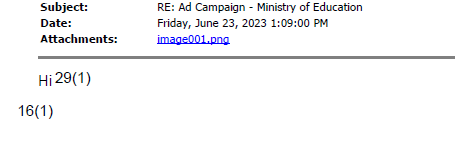
What came back was a heavily redacted set of emails, starting with one between a local Regina advertising agency that does work for several government ministries, sent to an official in Saskatchewan’s Ministry of Education.
The first email is dated June 21, 2023. The next email, dated June 23, 2023 has the subject line “ad campaign”.
(In the interests of maintaining some semblance of a relationship with officials in the Ministry of Education, I’ve left out the names of those who received the email.)
Despite the fact government has chosen to wipe out all of the content in the body of the email, the dates and subject lines are still interesting.
It seems planning for the billboards began no later than June 21, and likely well before that date.
However, opening proposals were not presented until meetings held on June 28 and 29th. That means the planning for the billboards began even before the two sides had exchanged proposals.
The Leader Post article quotes Charles Smith, an associate professor of political studies at the University of Saskatchewan.
Smith says whether the government is guilty of bargaining in bad faith is up to Saskatchewan’s Labour Relations Board. However, Smith says government appears to have been preparing these ads long before negotiations broke down.
“I think you can make a credible argument that there is an orchestrated campaign that is not interested in getting a deal done, and that could be evidence of bad faith.”
Prof. Charles Smith Regina Leader Post 16 February 2024
The Leader Post article also quotes STF President Samantha Becotte who says “I truly believe they have never come to the bargaining table with the intention of negotiating in good faith.”
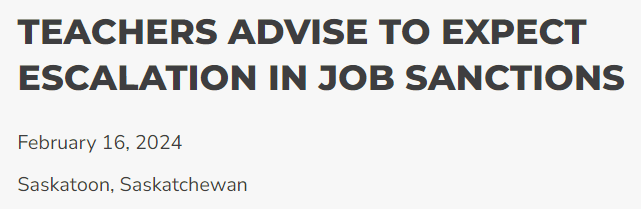
In a subsequent news release dated February 16, 2024, the STF advised teachers and members of the public to expect an escalation in job sanctions.
At issue is the government’s refusal to discuss teacher working conditions and student learning conditions. It is the position of the STF that class size (number of student) and classroom complexity (the nature, scope and scale of challenges facing individuals) should be part of the language in a new collective agreement.
“Unless they are willing to return to the table and actually negotiate, we have no choice but to continue using the tools available to us to hold them accountable. We know that this is a difficult and stressful situation for families. We want to give them as much notice as we can so that families can prepare. If you are tired of this, as we are, please call your local school board trustee and MLA to voice your concerns.”
Samantha Becotte, President STF News Release dated 16 February 2024
To everyone who attended the May 28th, 2021 session offered by the Saskatchewan Public Service Commission, thanks for your enthusiasm and participation. Here are the highlights from my presentation:
A lovely article this morning from UK lexicographer Susie Dent, who reminds us to seek out some positive words, instead of always relying on our extensive “thesaurus of hate”.
Something to remember the next time you’re asked to write something.
Few in the communications field spend much time delving into the works of cognitive linguists like George Lakoff (georgelakoff.com) or Noam Chomsky. That’s understandable, but unfortunate. The material is dense. However, it can be extremely useful when mapping-out a communications strategy. Research into how our brains are wired to use language and how we understand new ideas is key to effective communications, particularly in times of crisis.
If my years in politics taught me anything, it is this: There are a lot of people in the world who believe everyone thinks exactly as they do. And if they don’t share your belief, it’s because these people haven’t been given enough facts. This is sometimes referred to as the “rational person theory”. You try to influence people with piles and piles of facts, thinking they will be convinced to believe the same thing you believe. Unfortunately, this yields a predictably dull and ineffective communications strategy that doesn’t persuade people to consider embracing your point of view. It doesn’t entice or engage people into grappling with your ideas. To engage people, you need to better understand how language and the brain work.
When confronted with a new abstraction, say a new government policy or a new HR rule at work, we use conceptual metaphors as we attempt to understand this new thing. Put more simply we try to match something we don’t understand with something we do understand, usually beginning with the sentence “it’s like….”
You see examples of this in our conversations every day. Life is a journey, we’re in a rat race or we’re staying on track during the uphill battle that is our career. Conceptual metaphors for politics range from war to games to wargames.
This is particularly important when attempting to communicate something as part of a broader communications strategy. You need to engage people emotionally. You have to nudge them along as they move from the abstract notion to the concrete. Once that is achieved, they can begin grappling with your idea.
What some fail to appreciate is how important word choice is when attempting to help people along the way. As Mark Twain wisely observed, the difference between the right word and the almost-right-word is the difference between lightening and a lightening bug. The American political consultant Frank Luntz (https://twitter.com/FrankLuntz) made a similar observation in one of his books: Whether you call it a rabbit or a bunny makes a huge difference to people. Bunnies are cute. Rabbits destroy gardens. It makes a big difference.
I was reminded of this important when listening to an interview with Anat Shenker-Osorio on the Amicus podcast. The words you choose can make a huge difference. The entire show can be found here:
Shenker-Osorio is a communications consultant, researcher and author. She also has her own podcast dedicated to politics and language called Words to Win, which can be found here: https://wordstowinby-pod.com . The podcast delves deeply into language, messaging and politics.
Shenker-Osorio suggests a lot of political communications misses the mark in that it focuses and problem identification. She says that’s not an effective approach, since most people are not shopping around looking for new things to worry about. Presenting yourself in opposition to what others are doing seems to invoke a freeze response and “cements the sense that doing anything is futile”. By focusing complaints on others, you give those “others” oxygen (prime example: Donald Trump. As Lakoff said the best strategy is to just ignore him)
Shenker-Osorio gave a fascinating example from her work with economists on the huge difference word choice can make when it comes to influencing people’s perceptions:
“So, let me just give you a super-particular for instance. In an experiment we did a number of years ago, we brought people into a lab and we asked them to think about economic inequality. And we presented them with the facts the way that economists do—this quintile has this much, this quintile has that much, this quintile has that much, ect. We liken this abstraction which is a financial difference to a physical difference, a chasm—like the Grand Canyon. And, wealth is over here, and poor people are over there.“
“And for the other half of the sample, we said the economy is increasingly off-balance.Then we asked everybody “Is inequality a problem for the economy over-all. For our “gap” people, 80 percent of them said no, it’s not a problem for the whole economy. Twenty percent said ‘yes’ ”.
“The exact reverse proportion was true of our “off balance” people. Eighty percent said it’s a problem for the whole economy, 20 percent said it wasn’t.
So why is this? In reality, inequality is neither a gap nor an imbalance. And it’s also both. Because any time we need to refer to abstractions we default automatically and unconsciously to a conceptual metaphor. That’s just how we talk, right?“
(Amicus Podcast, Slate.com, 13 February 2020)
Echoing George Lakoff, Shenker-Osorio believes facts bounce off frames. Each of us has a conceptual metaphor that compares ideas to objects. She says this is the way we make sense of the world.
Telling people just the straight facts and then hoping they will arrive at the right conclusion is hopelessly misguided. To quote Shenker-Osorio, that’s just not the way the world works. People are sense-making machines that use language and their built-in conceptual metaphors to make sense of the world around them.
And you’d better be absolutely certain about the words you choose.
Saying something is part of a “gap” or saying the system is “off balance” can be the difference between a rabbit and a bunny.
An excellent vehicular analogy by Tim Harford, the economist, author, podcaster and Financial Times columnist. The debate he weights in on is whether it’s best to give as many people as possible the first dose of a two shot COVID vaccine, or hold back to make sure a smaller group of people get the second shot, according to the timelines recommended in clinical guidelines.
It’s an issue that was alive in Saskatchewan a few weeks ago.
Harford says with menacing variants increasing risk, the answer is obvious:
Cars are better with two headlights, and bicycles are better with two wheels. But while a bicycle with one wheel is useless, a car with only one headlight might be good enough in a pinch. The judgment here is that a single dose is more like a car with a single headlight than a bike with a single wheel. Given that these vaccines probably prevent the spread of the virus as well as preventing disease, it is possible that even people at the head of the queue might benefit if their second dose was temporarily redirected: if forced to drive in the dark, I would rather that every car on the road had one headlight than some two and some none. With a dangerous virus in wide circulation, we are all driving in the dark.









 Ian Hanna