

They’re called SPADS in Britain; special advisors. Flacks and hacks are common descriptions in North America. They are un-elected political advisors who can, and often do — exercise a significant amount of influence over the flow of political events. Political advisors can put out fires, but they can also create new or bigger conflagrations by what they do, or fail to do.
Do the job well, and you can be a significant asset to the people you work for. Do your job poorly and you undermine the electability and sometimes the very survival of your employer.
Witness events over the past few days in the UK, which offer some important lessons about the role played in politics by un-elected advisors and the limitations of these roles when clear direction from elected officials is lacking.
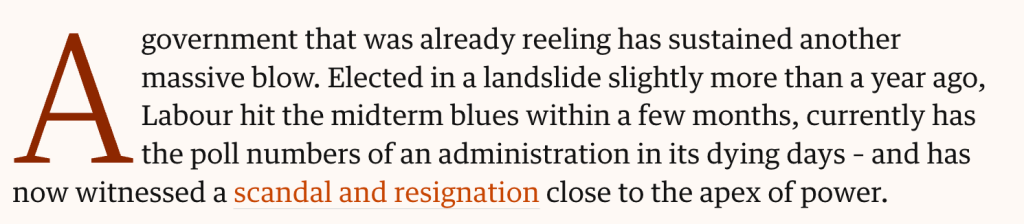
The first lesson (what advisors should have fixed by didn’t) is seen in the resignation of Angela Rayner, the former Deputy Prime Minister of the United Kingdom. She resigned 04 September 2025 after running afoul of newly-strengthened Ministerial ethics regulations (strengthening she wisely advocated after the ethical shambles and lack of accountability demonstrated by the previous Conservative government).
Rayner’s story is complicated, but here’s the essence: She placed her home in a trust for the benefit of her disabled son. Then, she used funds gained from that transaction to purchase a new residence and sought out legal advice about whether she had to pay a higher tax rate for that transaction.
Rayner was told everything seemed fine, but that trusts are complicated things and she should seek advice from experts in taxes and real estate trusts.
She didn’t do that.
Rayner was found to be in breach of the new Ministerial code and resigned a few hours later.

Her advisors had a duty and an obligation to be candid, assertive and scrupulous in their insistence to get that proper legal advice, particularly given the political context of these events. She was the Minister in charge of the government’s housing reforms, meaning any of her real estate transactions would be the subject of extra scrutiny. Plus she was a very high profile, aggressive and very partisan critic of her political opponents. And in politics, if you live the the sword, you die by the sword (But as Churchill noted unlike soldiers, politicians get to sometimes rise and live again).
That extra legal advice was never sought. Rayner’s advisors didn’t seem to see or appreciate what might be coming, so they didn’t insist. That’s weak staffing, something of a pattern for Ms. Rayner, according to Spectator journalist James Heale:
“Angela Rayner was the favourite to be the next Prime Minister. And I think that was fair to say. But I remember them offering two “health” warnings: One of them was that she had a very complicated personal life and that she didn’t have a great team around her. And I think in the past week we’ve seen the shortcoming of both of those.”
James Heale. Spectator Podcast. 05 September 2025
Sometimes, politicians hire weak staff because they are difficult to work for and don’t attract top talent that will actually help-out when times get tough. Sometimes, politicians hire weak staff because they just don’t like being constantly challenged.
I don’t know why this happened in Angela Rayner’s case and it probably doesn’t really matter. What does matter is that politicians who think they can do it all on their own inevitably run into trouble.
The second lesson from the past few weeks (what advisors can’t fix) is that advisors are no substitute for clarity of vision and purpose. Want to trip-up a new politician? Ask them why they’re running, what it is they want to accomplish, what they plan to do first and how they intend to do it.

A year after his stunning election victory, UK Prime Minister Keir Starmer is watching his popularity drop precipitously as his government struggles to articulate a coherent vision. And this is where political advisors are of limited utility. If it is the job of political advisors to provide the means to get a party where it wants to go, it is clearly the function of an elected leader to set the course and explain why we all need to be headed in the same direction. Politicians provide answers to the “what” and the “why” questions. Advisors answer the “how” questions.
Daniel Finkelstein writes for The Times and has offered sage advice to many Conservative UK Prime Ministers. According to Mr. Finkelstein, it is the job of political leaders alone to be a government’s chief political advisor while defining what kind of government they are leading:
“These people (senior advisors) cannot determine what the government is. There’s only one person who can do that really and that is the Prime Minister himself. He has to know that for himself. If you look at all the successful Prime Ministers, they knew in themselves what they were trying to do, who they were. And they were the chief political advisors to the government.
The political strategy of Labour under Blair or (Tories) under Cameron or Margaret Thatcher, you know, everyone will have their views about their respective successes in politics. But each of them had an idea about what they wanted their government to be. And the government followed them, and they employed talented people .”
“The government is led by the Prime Minister and if this government doesn’t have a clear political identity or a clear political message and it doesn’t know exactly what it’s doing, that is where the problem is… (with the leader).
Daniel Finkelstein, The Times “How to win an election” podcast 04 September 2025
And what holds true for UK Prime Ministers also holds true for Canadian Prime Ministers, provincial Premiers and even opposition leaders: Articulate a clear vision and explain why your priorities are important. Then, hire the people with the knowledge, experience and confidence to help you get to where you want to go.
 Ian Hanna