

Many hours of my political life were spent pondering Question Period. In Opposition, you’re looking for that one, concise phrase that cuts through the government’s rhetoric and makes your proposal or point of view more compelling and engaging. In Government, you’re looking for that clean, crisp, logical narrative illustrating your values and compelling voters to adopt your point of view. It’s fun when it works, not so much fun when it crashes.
Have a look at Prime Minister’s Questions (PMQs) in the UK to see the art form playing out at its highest level. When the UK Parliament is in session, The Prime Minister must answer questions from members for an hour every Wednesday. But there’s a bit of a break: Unlike the rules in Saskatchewan and other Canadian legislatures, the UK Prime Minister gets a few friendly questions from his own party members (Does the Prime Minister agree his government is doing a great job….).
It’s no surprise that PMQs get a tremendous amount of media attention. This becomes amplified when new players are introduced, like the new Conservative leader Kemi Badenoch. Recently, The Guardian’s Andrew Sparrow noted several right-wing media commentators were less than enthusiastic with Badenoch’s previous two PMQ outings. She is being criticized for performances in PMQs that have been something less than compelling.
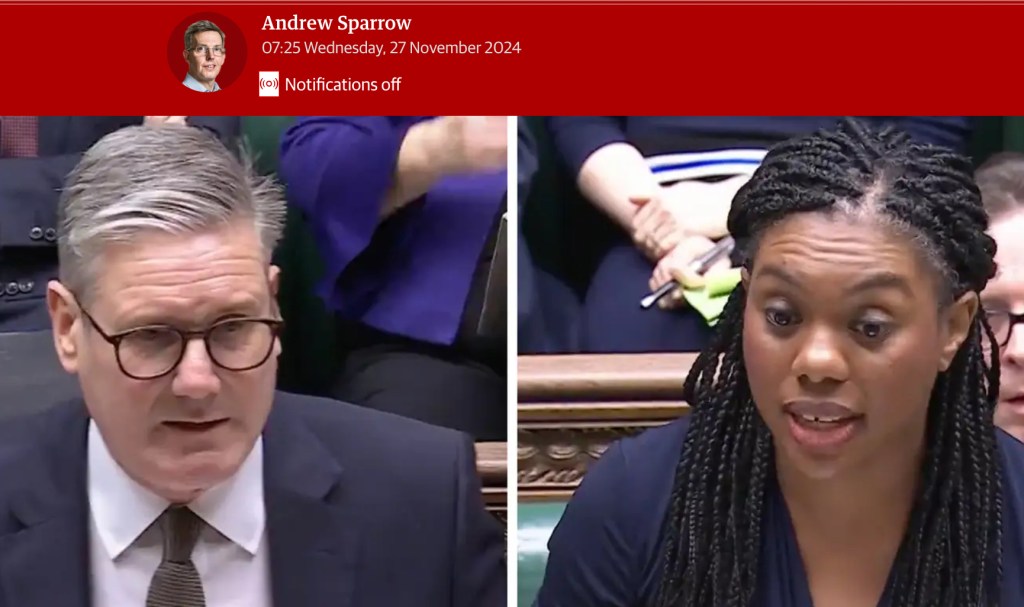
To use communications jargon, Badenoch wasn’t cutting through. She wasn’t saying anything memorable or offering a clear vision that can compete with the government’s official narrative.
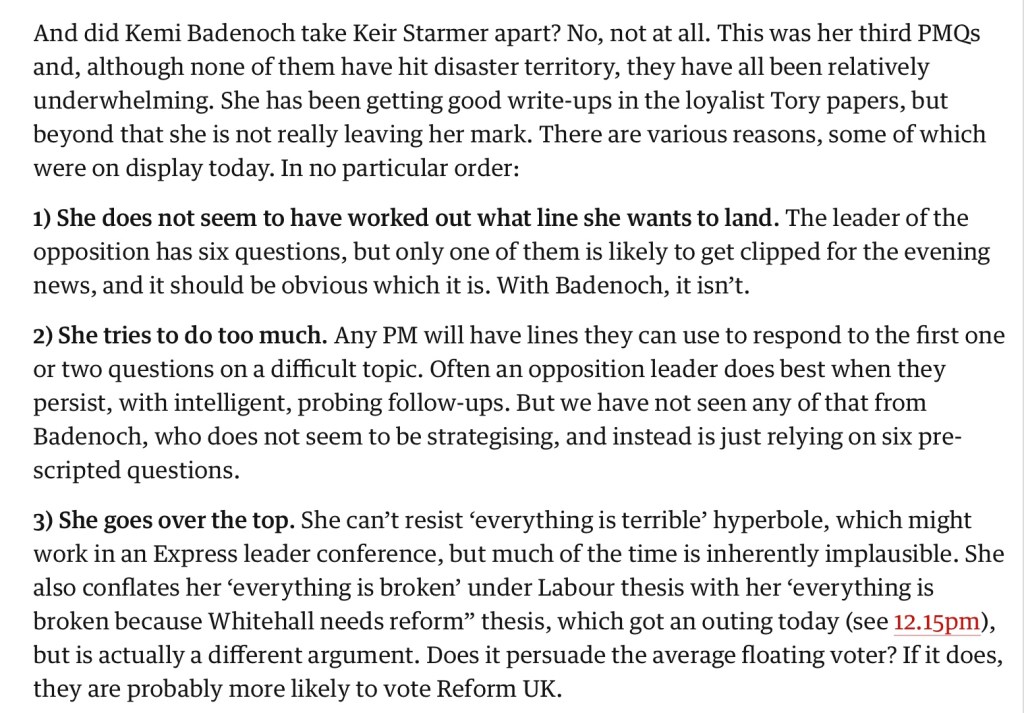
Sparrow offers an interesting analysis as well as a recipe for improvement for Badenoch. And when applied more broadly, Sparrow’s points could be constructively applied to any situation where someone has to communicate a point of view to an audience — whether it be in the media or any other setting.
Know what you want to say.
Sparrow’s first criticism of Badenoch is that she doesn’t seem to have worked out “where she wants to land”. I saw this frequently in my career: messaging seemed vague or confusion because no one was absolutely sure exactly what the message was. This is poisonous. If you don’t know what it is you are trying to say, it’s incredibly difficult to developing clear and coherent key messages. And, as is often said in communications, if you have six messages, you don’t have any message. Often, political actors finished an interview only to be mystified by the quote that was picked. Well, if you pick a bunch of different options, don’t be surprised by the final choice that’s made. Or, stick to one basic message and find several different creative ways of articulating that message.
Saying too much all at once.
This is such a common problem. When asking or answering a question or giving a presentation, people speak way too quickly. They try to get everything out as rapidly as possible. In an interview situation, there is a tendency to answer every potential question in the first response, perhaps feeling you won’t get a second chance. You likely will, so just slow down, listen to the question and attempt to answer it as best as you can in a forthright manner.
In the context of Question Period, I’ve been the poor staffer that provides the politician with five or six questions along with the admonition to listen and adjust the questions in light of information contained in the answers. Sadly, this kind of thinking on your feet is a rare skill. However, people improve with practice.
Going over the top
After a few weeks in government, it soon becomes obvious you require a different set of skills than those which caused you to prosper in opposition. For example, the phrase “we will never…” should likely be banned. As Joe Biden discovered, having your handlers say you will never pardon your son isn’t helpful when you decide to pardon your son. It’s corrosive, and damaging to your long-term credibility. While absolutes provide temporary comfort, they are damaging in the long haul. At most, you can default to phrases like “I can’t imagine a set of circumstances where I would…” but even that permanently closes some doors you may wish to open later. And always remember: you are stuck with what you said publicly for as long as you are in public life

Tone is important
As Maya Angelou famously said “It’s not what you say that people remember, it’s how you made them feel”.
You convey some of your message using words, some with tone. If you sound patronizing, people will feel patronized. If you sound angry, listeners will think you are angry. An old trick in media training is to have someone look at one of their recent interviews with the sound off. Invariably, you will pick up signals that suggest tone or mood. Your posture will betray you if you feel anger. Your shifting eyes and shuffling will suggest nervousness. Leaning forward and offering direct eye contact to your inquisitor will convey sincerity. Tone is as important to strategic political messaging as content. The problem is people anguish over content and pay no attention to tone or appearance.
Invariably communicators improve over time with lots of practice. Natural skills will only get you so far when delivering a narrative, political or otherwise. However, you need to be mindful of tone. You need to have a clear sense of what it is you want to say, and how best to articulate your message. You also need to consider how your opponents will respond and how best to calmly and rationally meet those concerns.
In many federal briefing notes, I’ve seen content under the heading “Desired Media Headline”. It’s good to know what the target was/is, even if you’re not going to get there. The renowned nature photographer Ansel Adams used a process he described as “pre-visualization” before he tripped the shutter. What will this photo look like? What do I want it to look like? What adjustments in position/exposure/lighting could be made to achieve that goal? Political messaging would improve if the messengers adopted a similar practice.
Those attempting to deliver an important message in politics, parenting, business or any other relationship would be wise to remember Mr. Sparrow’s sound advice. Think about what you want to say. Think about the best way to say it. And think about how people will respond. Think about tone. Don’t go over-the-top. And be mindful of tone. Make people believe you are actually interested in the problems they face and that you come equipped with some workable solutions.
 Ian Hanna